T.W.A.T.: The Bedroom
“In our culture privacy is often confused with secrecy. Open, honest, truth-telling individuals value privacy. We all need spaces where we can be alone with thoughts and feelings – where we can experience healthy psychological autonomy and can choose to share when we want to.” – bell hooks, All About Love: New Visions
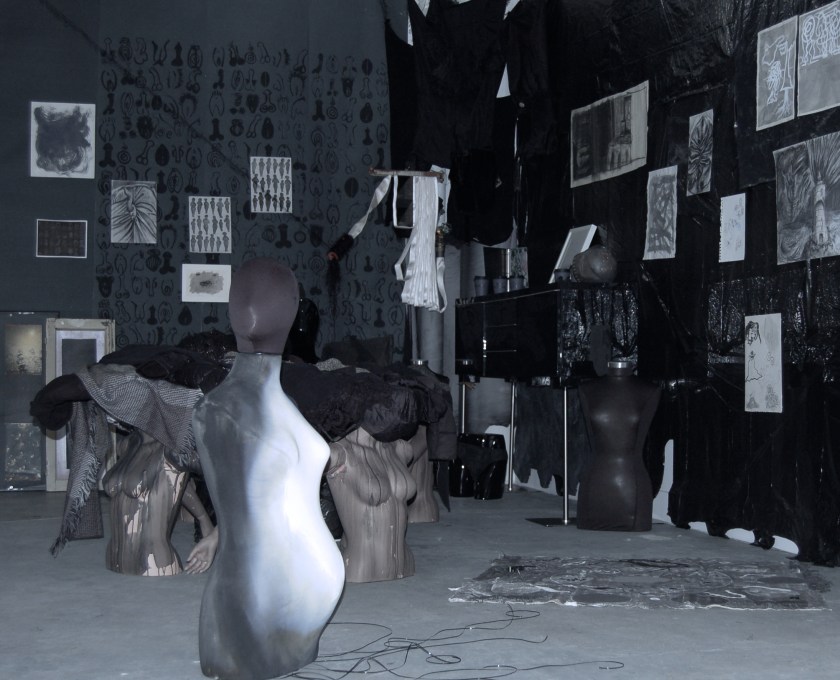
Visitors enter the intimate space and interact with the furniture, objects, and personal items located within T.W.A.T.: The Bedroom. As in a typical bedroom, the installation includes a bed, chest of drawers, chairs and wardrobe. Everything is monochromatic and the installation includes photos, kinetic works, sculptures, painting, ceramics, clothing, sound, textiles, video, and found objects.
Privacy can be defined as the ability of an individual or group to seclude themselves, or information about themselves, and thereby express themselves selectively. Virtually unknown in some cultures until recent times, the concept of privacy is developing roughly congruent to the proliferation of the individual, private bedroom. Although the percentage of personal space per capita is continuing to expand in Western society, our personal privacy in some ways is eroding, especially with regard to omnipresent communication and surveillance through technology.
The private bedroom, largely a Western invention of the late 18th / early 19th centuries, a luxurious space, a container for sex, death, and dreams, is a relatively recent development. As the middle class continues to expand globally the notion of a private bedroom continues to gain traction. Contemporary social scientists posit that the concept of universal individual privacy is a modern construct mainly associated with Western culture, and that privacy may be understood as a prerequisite for the development of a sense of self-identity and bodily integrity. Our concept of self, “the me”, cannot develop without some degree of privacy.
Bedrooms function as a secondary uterus where gestation of the self transpires. Conversely, bedrooms can also function as a chamber of secrets housing domination, degradation, or physical harm. As an interactive immersive artwork T.W.A.T.: The Bedroom simultaneously constrains and expands our sense of self and bodily integrity.
Inviting the public into a personal space and giving them the ability to transgress normative personal boundaries through visitors’ ability to interact with any and all objects situated within T.W.A.T.: The Bedroom can be interpreted as an exploration of boundaries, asking us to consider personal limits and transgressions that take place within both the private and public realms.
Totally familiar, yet completely unreal, T.W.A.T.: The Bedroom functions as a heterotopia. Sensorily immersive environments invite us to inhabit our bodies while total transformation of a familiar trope asks us to consider / examine our version of reality.
T.W.A.T.: The Bedroom also functions as a symbolic arena for inward exploration and personal growth. Its dramatic monochromatic space is a giant interactive photo booth, a “selfie” backdrop, a locus of exploration for one’s public persona. The Selfie as a phenomenon arises out of the increased isolation and separateness that private bedrooms have allowed us to cultivate. We literally create a space for personal growth and development and the sense of isolation that happens when that space loses its correct function. T.W.A.T.: The Bedroom also exists as a tool for exploring human sensory perception, camera perception, presentation of the self, boundaries of self and other, and attributes of the public and private realms.
Interestingly, Foucault uses the concept of a mirror to illustrate his concept of heterotopia: “A mirror is metaphor for utopia because the image that you see in it does not exist, but it is also a heterotopia because the mirror is a real object that shapes the way you relate to your own image.”
Celebrating woman in her infinite variety, The Women Artist Team, TWAT, embraces contemporary artists of all creeds, races, tribes, affiliations, and age self identifying as women. TWAT celebrates the power of the pussy, the yin principle, the feminine force, the vitality of the vagina. TWAT and The Bedroom were conceived of and founded by Paula Lalala.
({})
T.W.A.T.: The Bedroom
in Process

From the Domain of Paula.

All Content © 2021
 The Women Artist Team